 EN
EN

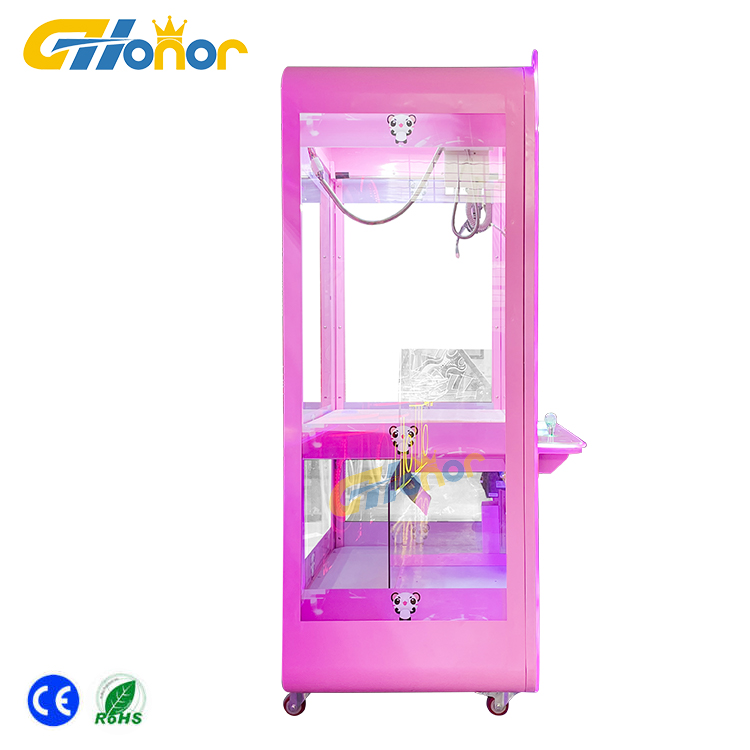
Why Mini Claw Machines Are Essential for Space-Constrained Arcades
Arcade operators face intense pressure to maximize revenue per square foot—especially in urban venues where floor space often costs over $200/month per sq ft. Mini claw machines solve this challenge by occupying less than 4 sq ft—nearly 60% smaller than standard models—while delivering comparable player engagement. Their compact footprint enables strategic placement in high-traffic zones traditional machines can’t reach: narrow entryways, between pillars, or even mounted vertically. This spatial efficiency allows venues to double their unit density, directly boosting revenue potential without expansion costs.
Operators report 30% higher per-square-foot earnings after deploying mini units in underutilized areas like concession counters or queue lines. Unlike bulkier alternatives, these machines maintain full functionality with precision-gripping mechanisms and prize capacity scaled for compact dimensions. For venues under 1,000 sq ft, integrating mini claw machines transforms spatial limitations into competitive advantages—proving essential for sustainable profitability in today’s market.
Key Design Principles for Reliable Mini Claw Machine Construction
Designing sub-24" units demands meticulous engineering to maintain play integrity while minimizing space consumption. Excessive frame reduction compromises stability; according to a 2023 Amusement Equipment Durability Report, improperly reinforced compact machines experience 37% more structural failures than optimized counterparts. Leading manufacturers address this through triangulated steel subframes and weighted bases, distributing operational stresses without expanding footprints. This balance prevents tilt-induced misalignment during grabs while preserving arcade floor efficiency.
Balancing Structural Integrity and Footprint in Sub-24" Units
Every centimeter matters in compact claw machines. Engineers employ Finite Element Analysis (FEA) simulations to identify critical stress points in scaled-down designs. These models reveal that reinforcing corners with gusseted joints increases torsional rigidity by up to 52% without adding width, as demonstrated in peer-reviewed robotics studies. Additionally, recessed mounting systems embed electronics within chassis walls, reclaiming 15% internal volume for mechanics while maintaining external compactness.
Optimal Materials and Tolerances for Durable, Compact Builds
Material selection dictates longevity in miniature claw machines. Powder-coated aircraft aluminum (6061-T6 alloy) dominates high-performance models, offering 40% higher strength-to-weight ratios than standard steel according to ASTM testing. For friction-prone components like gear tracks, self-lubricating polymers with ±0.01mm tolerances prevent particulate buildup in confined spaces. This precision extends mean-time-between-failures beyond 10,000 cycles in commercial environments, matching full-sized machine reliability.
Smart Integration: Mounting, Clustering, and Hardware Compatibility
Modular Frame Systems for Multi-Unit Wall or Kiosk Installation
Modular frame systems revolutionize space utilization for mini claw machines in crowded arcades. These aluminum extrusion-based frameworks enable vertical stacking or clustered arrangements on walls and kiosks, tripling unit density within six-square-foot zones. Universal mounting brackets accommodate cabinets up to 24 inches wide while transferring zero operational vibration to adjacent units. Integrated cable channels and standardized power connectors eliminate tangled wiring, cutting installation time by 40% during field tests. Quick-release mechanisms allow operators to swap malfunctioning units in under five minutes without tools, maximizing uptime. The systems meet UL safety standards for public spaces and resist corrosion from constant handling. Clustered configurations generate 30% higher player traffic by creating focal entertainment hubs. Precision-milled joints maintain structural integrity during relocation, supporting frequent layout changes. This flexibility transforms cramped corners into revenue-generating attractions without compromising foot traffic flow.
Micro-Scale Claw Mechanism Performance: Precision, Torque, and Reliability
3D-Printed Actuator Components and Torque-to-Size Optimization
Advanced 3D printing allows tailored polymer actuators in mini claw machines to achieve torque densities 30% higher than conventional metals per cubic centimeter—critical for confined arcade footprints. By optimizing gear geometry and wall thickness through topology algorithms, these micro-components deliver precise ±0.05mm claw positioning while sustaining over 8,000 operational cycles—exceeding industry durability benchmarks. The elimination of assembly tolerances in monolithic printed designs reduces backlash to under 0.1°, ensuring consistent prize retrieval in high-traffic venues. This material efficiency enables torque-to-mass ratios ideal for sub-24" cabinets, balancing 5N·m gripping force with energy consumption below 40W during peak operation. Integrated copper-nickel bearings further enhance heat dissipation, maintaining positional accuracy across extended sessions without performance degradation. Such innovations transform space-constrained installations into revenue-generating assets without compromising reliability.
FAQ
Why are mini claw machines preferred in space-constrained arcades?
Mini claw machines are preferred in space-constrained arcades because they occupy less than 4 sq ft of space, nearly 60% smaller than standard models, while providing similar player engagement. This compact size allows for strategic placement in high-traffic areas that traditional machines cannot access, such as narrow entryways and between pillars.
How do mini claw machines maintain functionality despite their compact size?
Mini claw machines maintain full functionality through precision-gripping mechanisms and prize capacity scaled for compact dimensions. They are engineered to deliver comparable functionality to standard-sized machines without sacrificing performance.
What materials are used in the construction of mini claw machines?
Mini claw machines are often constructed using powder-coated aircraft aluminum (6061-T6 alloy) for high strength-to-weight ratios. For friction-prone components, self-lubricating polymers with ±0.01mm tolerances are used, ensuring longevity and reliability in confined spaces.