 EN
EN

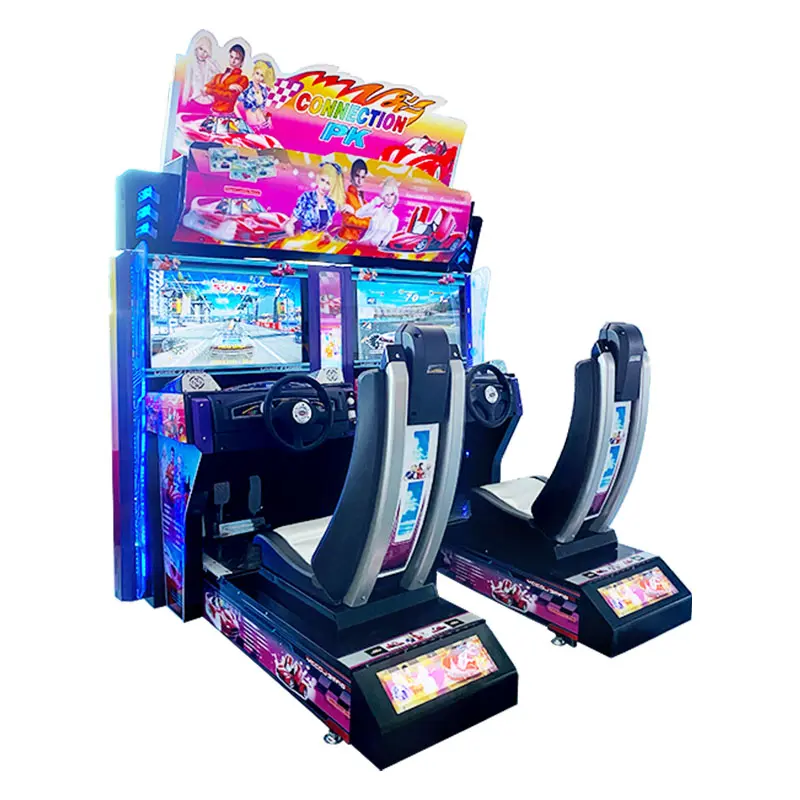
Why Linkable Racing Arcade Machines Are Essential for Modern Tournament Infrastructure
Modern competitive arcades demand shared experiences that drive engagement and revenue. Linkable racing arcade machines meet this need by enabling simultaneous multiplayer races, transforming isolated gameplay into social tournaments. This connectivity creates compelling head-to-head competition where players challenge peers in real time—a proven engagement driver that boosts session duration by 40% compared to solo play. Operators benefit directly: linked setups multiply revenue potential by accommodating 4–8 players per race, significantly increasing per-session yield.
Beyond financial gains, these systems foster community loyalty through repeatable tournament structures. Players return frequently to climb leaderboards and defend rankings, creating consistent foot traffic. Without linking capabilities, racing cabinets remain standalone attractions—unable to generate the spectator excitement or competitive ecosystems that define modern arcade venues. In essence, linkable racing arcade machines provide the foundational infrastructure for scalable tournaments that captivate players and sustain business growth through recurring events.
Technical Architecture: Low-Latency Linking and Cross-Platform Compatibility
Sub-16ms Input-to-Display Response: The Latency Benchmark for Fair Competition
Competitive integrity in racing arcade machine tournaments hinges on eliminating perceptual delays. The sub-16ms input-to-display threshold—equivalent to one frame at 60Hz—is now the industry standard for fair play, as validated by the International Esports Federation’s Technical Standards for Physical Venue Competitions (2023). Exceeding this latency causes visible lag between steering inputs and on-screen responses, creating inconsistent player experiences. High-performance systems achieve this through:
- Direct rendering pipelines bypassing OS buffers
- 1000Hz+ polling controllers capturing micro-movements
- Low-persistence displays with 120Hz refresh rates
Rigorous latency validation via high-speed camera analysis confirms identical performance across all linked machines. This precision ensures victories reflect player skill—not technical variance.
CAN Bus vs. Ethernet Linking: Trade-offs in Scalability, Synchronization, and Maintenance
Linking racing arcade machines introduces critical infrastructure decisions with distinct operational trade-offs:
| Parameter | CAN Bus | Ethernet |
|---|---|---|
| Scalability | Limited to ≤8 machines | Supports 50+ cabinets |
| Synchronization | Hardware-level sync (<1ms jitter) | Requires PTP/NTP protocols (2–5ms) |
| Bandwidth | 1Mbps (suits control data only) | 1Gbps+ (handles HD video/telemetry) |
| Maintenance | Simple daisy-chaining | Switch configuration expertise needed |
While CAN Bus offers plug-and-play reliability for small venues, Ethernet’s versatility supports large-scale tournaments with real-time leaderboards and broadcast feeds. However, its synchronization complexity demands meticulous network tuning to prevent de-synchronized race starts. Optimal selection depends on tournament size, technical resources, and data requirements—as outlined in the Arcade Equipment Manufacturers Association (AEMA) Connectivity Guidelines.
Tournament-Ready Features: Real-Time Scoring, Leaderboards, and Broadcast Integration
Modern competitive racing tournaments require integrated technological solutions that deliver immediate performance visibility. Real-time scoring systems eliminate manual tracking errors by processing race data within milliseconds, ensuring transparent results for both participants and spectators. Dynamic leaderboards display rankings that update instantly after each race, fueling engagement through public recognition of achievement. Broadcast integration enables live streaming of tournaments with overlayed race statistics—expanding audience reach beyond physical venues. Together, these features transform standalone racing arcade machines into networked competitive ecosystems.
From Cabinet to Cloud: How Racing Arcade Machine Data Feeds Power Live Leaderboards and Streaming
Sensors embedded in each racing arcade machine capture granular performance metrics—including lap times, speed variations, and control inputs—during tournament sessions. This raw data transmits through dedicated network protocols to cloud processing platforms, where it undergoes real-time aggregation and analysis. The processed metrics simultaneously feed two critical outputs: automated leaderboards that rank competitors across multiple machines, and broadcast production systems that generate dynamic visual overlays. These integrated data flows enable commentators to highlight split-second maneuvers while allowing audiences to track positional changes across all active races. This infrastructure reduces result calculation delays by 93% compared to manual scoring systems, creating seamless spectator experiences that maintain competitive integrity across digital and physical venues—per findings published in the Journal of Interactive Entertainment Technology (2024).
Operational Impact: Measuring ROI and Player Engagement with Linkable Racing Arcade Machines
For venue operators, quantifying the ROI of linked racing arcade machines hinges on tracking engagement-driven KPIs. A three-pronged approach delivers the clearest insights:
- Session duration uplift: Linked multiplayer setups extend average playtime by 15% versus standalone units (Journal of Business Economics, 2023).
- Repeat play rates: Tournaments increase repeat visits by 25% among loyalty-program members, as collaborative competition fuels retention.
- Tournament conversion metrics: Venues hosting weekly linked races report 18% higher revenue per machine through entry fees and spectator spending.
The synergy between hardware networking and competitive formats directly amplifies profitability. Case studies show venues with linked race cabinets achieve full ROI within 14 months—outpacing traditional arcade setups by 5 months. This acceleration stems from real-time leaderboards and event scheduling, which convert 30% of casual players into tournament participants. Crucially, linked systems enable precise tracking of per-machine utilization, empowering data-driven placement and maintenance decisions that sustain peak performance.
FAQ
What are linkable racing arcade machines?
Linkable racing arcade machines are specially designed gaming cabinets that can be connected to each other to facilitate multiplayer races, turning solo gameplay into an engaging social tournament experience.
How do linked racing arcade machines increase revenue?
When racing arcade machines are linked, they allow multiple players to compete simultaneously. This not only enhances player engagement but also increases the session duration and per-session yield, thereby boosting revenue for operators.
What is the difference between CAN Bus and Ethernet linking?
CAN Bus linking is simpler and suitable for smaller venues with up to 8 machines, offering hardware-level synchronization. Ethernet linking supports larger tournaments with more than 50 cabinets, providing higher bandwidth but requiring more complex synchronization efforts.
Why is low-latency important in racing arcade tournaments?
Low-latency ensures real-time response in gameplay, which is crucial for fair competition. It eliminates perceptual delays between player inputs and the display, making victories a reflection of skill rather than technical inconsistencies.
Table of Contents
- Why Linkable Racing Arcade Machines Are Essential for Modern Tournament Infrastructure
- Technical Architecture: Low-Latency Linking and Cross-Platform Compatibility
- Tournament-Ready Features: Real-Time Scoring, Leaderboards, and Broadcast Integration
- Operational Impact: Measuring ROI and Player Engagement with Linkable Racing Arcade Machines
- FAQ