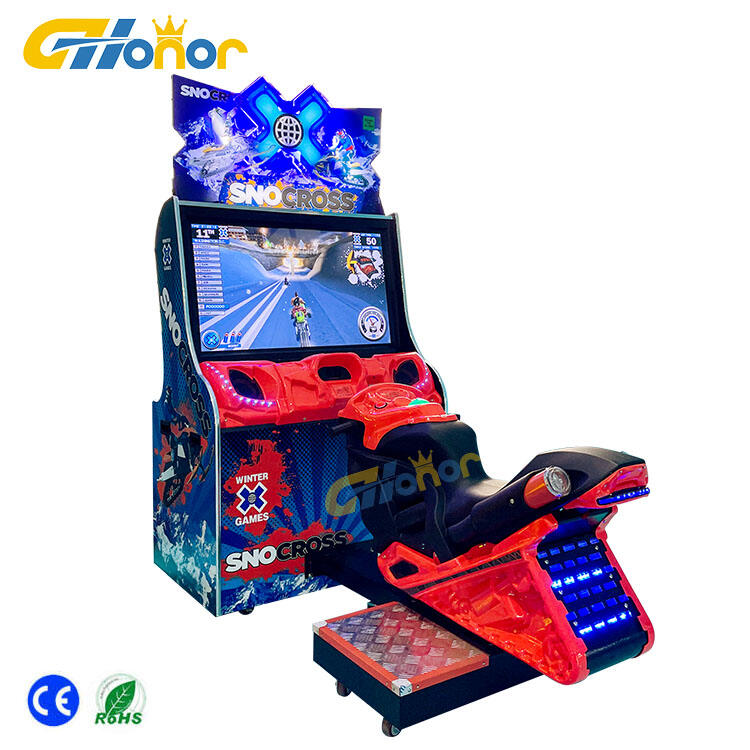
A realistic racing arcade machine is a specialized gaming device that prioritizes authentic driving dynamics, detailed simulations, and immersive sensory feedback to replicate the experience of real-world racing, appealing to enthusiasts and casual players alike who seek a true-to-life driving challenge. These machines bridge the gap between arcade-style fun and professional racing simulators, offering a balance of accessibility and realism that makes them standout attractions in entertainment venues. At the heart of realism is advanced physics modeling, which simulates vehicle behavior with precision—factors like weight distribution, tire grip, aerodynamics, and suspension response are accurately replicated, meaning cars handle differently based on speed, track conditions, and vehicle type. A sports car will accelerate faster and corner sharper than a truck, while rain or gravel on the track will reduce traction, requiring players to adjust their driving style, just as in real racing. Steering wheels feature sophisticated force feedback systems that transmit nuanced sensations: resistance increases during tight turns, vibrations occur over rough surfaces, and sudden jolts simulate collisions or loss of control, providing tactile cues that enhance decision-making. Pedals are pressure-sensitive, with braking intensity affecting stopping distance and acceleration responsiveness mimicking real throttle control, allowing for techniques like heel-toe shifting in manual transmission models. Visuals contribute significantly to realism, with high-definition displays rendering tracks, vehicles, and environments in meticulous detail—from the texture of asphalt to the reflection of sunlight on car bodies. Many machines feature licensed vehicles from manufacturers like Ferrari, Porsche, or Lamborghini, with accurate models, engine sounds, and performance characteristics, adding to the authenticity. Tracks often include real-world circuits (e.g., Nürburgring, Monaco) with precise layouts, elevation changes, and landmarks, further blurring the line between virtual and reality. Additional sensory elements like motion platforms that tilt with turns, surround sound systems that deliver directional audio (e.g., the roar of an approaching opponent), and even simulated wind effects enhance immersion. Game modes emphasize realistic challenges, such as time trials against professional lap records, endurance races with tire wear, or weather-changing conditions that force strategy adjustments. By combining accurate physics, detailed visuals, tactile feedback, and authentic content, realistic racing arcade machines offer players an experience that feels less like a game and more like stepping into a race car, making them a favorite among those who appreciate the skill and nuance of real racing.
 EN
EN